

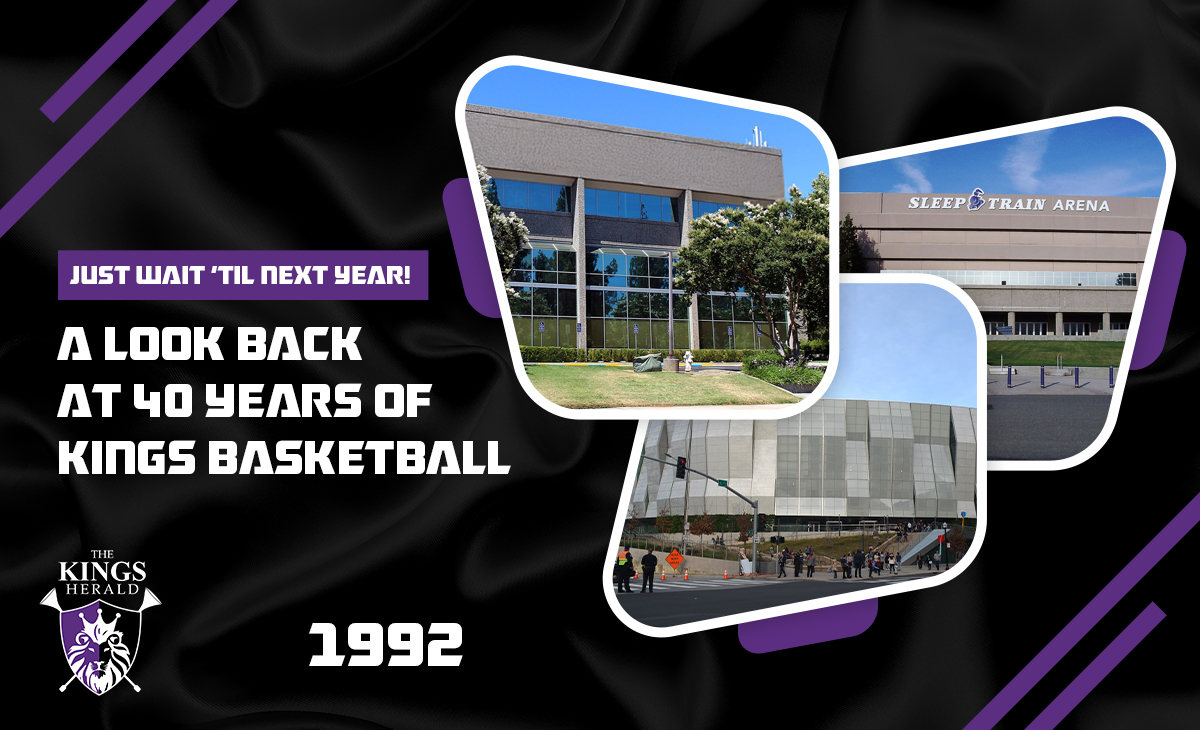
(Welcome back to our off-season series, “Just Wait ‘til Next Year!” in which special guest Jerry Reynolds and I bring you our 147 combined years to bring you our recollections of past Kings years.)
As the Kings entered their eighth season in Sacramento, searching for their second playoff berth, the Chicago Bulls were coming off back-to-back championships. The Bulls won a total of 128 regular season games over the past two seasons, the exact same number that the Kings had won over the past five seasons.
Let’s Kings Basketball!
Being a Kings’ season ticket holder meant having a great seat when Michael Jordan, David Robinson, Charles Barkley or Patrick Ewing came to town, but it also fortified that the local squad was really in a different league than a good many of the NBA teams. The Kings were the NBA’s Washington Generals, with one notable exception: the Kings were actually pretty formidable at home. This was an era where the Kings were truly the only game in town, and the locals continued to sell out the arena and sell out their vocal cords on a nightly basis. When the fans collectively stomped their feet, the whole place shook. The Kings managed a 21-20 home record the prior season (8-33 road). Yes, the 29-53 Kings of 1991-92 had a better home record than your 2024-25 play-in Kings (20-21). But I’m not bitter, and that’s the important thing.
The 1992 off-season began with the Kings hiring Garry St. Jean as their new head coach. St. Jean had all of the energy and charisma that prior head coach Dick Motta lacked (to be fair, the Jibboom Street Bridge had more energy and charisma than Motta), and he promised an up-tempo, exciting brand of basketball. The Kings used the 7th pick of the draft to select Walt Williams out of Maryland. “The Wizard” as he was known, rocked the knee socks long before they became an NBA fashion staple.
One of the biggest acquisitions that the Kings made was when they traded Vincent Askew for the 1993 second round draft pick that would become Mike Peplowski – stick a pin in this for next season.
The Kings started the season with an intriguing core: Richmond and Spud Webb made up the back court, with Randy Brown and Walt Williams behind them. Williams would also spend some time behind small forward Lionel Simmons. Duane Causwell and Wayman Tisdale were up front, with Anthony Bonner behind them. Rod Higgins, Jim Les and Pete Chilcutt rounded out the bottom of the rotation.
Oh, did I mention Kurt Rambis was a Sacramento King in 1992-93? Kurt Rambis was a Sacramento King in 1992-93. Good grief. What was next, Vlade Divac?
The Kings began the season 6-8 before losing eight straight. They then followed that with six straight wins, brining their record to 12-16, including back-to-back overtime ROAD wins. The Kings had fallen to 16-30, but Mitch Richmond was heading to his first All-Star game as the first Sacramento Kings All-Star representative. On February 11, a week prior to the All-Star game, Mitch Richmond attempted to steal the ball from Atlanta’ Mookie Blaylock, resulting in a broken thumb. Richmond would miss the All-Star game, as well as the rest of the season. The Kings would lose eleven of their next twelve and 8-27 after the Richmond injury. Not that the .362 winning percentage prior to the injury was a reason to prepare the ticker tape, but it was substantially better than the .229 mark that came after the injury. The consolation prize was seeing a bit more of Williams and Randy Brown.
The Kings were 12-12 at home with Richmond, 4-13 without. Suffice to say that this team was only as good Richmond’s back would carry them. They may have been only a 30ish win team with him, but they weren’t a 20ish win team without him. Batman? Robin? This was the Lone Ranger, and there was not a Tonto on the horizon.
Gregg Lukenbill was more than out of money at this point and sold the team to the Jim Thomas group. Lukenbill’s Kings would wind up with an aggregate winning percentage of .356 (prorates to 29-53 annually), the lowest of any Sacramento era owner. Lukenbill’s vision outpaced his financial support, and while it impacted the product that was on the floor, Lukenbill brought the major leagues to Sacramento. Modern day Kings fans will reference the efforts of Vivek Ranadive as it pertains to saving the Kings for Sacramento, but there is nothing to save if not for Gregg Lukenbill. A perfect man? Hell no. Who is? Deserving of a statue in the G1C Plaza?
You-Better-Go-Damned-Believe-It.
Reynolds’ Wrap
“Another season and new ownership group. Sound familiar? Anyway, I have a few observations of changes made during the offseason. Jim Thomas, the majority owner made it known that he would not keep Dick Motta as coach and learning that, Dick resigned before season ended. His assistant, Rex Hughes took over and did a solid job the remainder of the season. Thomas wanted to form a selection committee and start the coaching search (yes we had one). Myself, Scouting Director Scotty Stirling, Team President Rick Benner along with Thomas were it. We interviewed five candidates. Two declined the opportunity. The five candidates were as follows: Rex Hughes, Del Harris, Garry St. Jean, Randy Pfund, Jon Wetzel. After two days of interviews, each twice, we made our selection. Three selected Harris and one for St. Jean. Later, St. Jean was named the next Kings coach. The one vote happened to be from Jim Thomas. Saint was a solid coach and great guy. However, it was now apparent to us how decisions would be reached. Just another dose of NBA reality! I do feel Harris, Basketball Hall of Famer, was the better choice.” – Jerry Reynolds
***
1992-93 felt like an amuse bouche due to the Richmond injury. The Kings had a star, a head coach, some complementary players, and the seventh pick in the draft. I don’t hear a whistle, so that must be light at the end of the tunnel? Just Wait ‘til Next Year!



I have little to no recollection of that season. I was also a teenager who was into girls and music at that time. The early to mid/late 90’s was touch and go in my Kings fandom. Soooo many other distractions at that time.
Girls as a teenager was the only choice ! Very normal interests at that time . Kings ? Now, but most appreciate and understand on this site .
A mention of Mike Peplowski, which means Bobby Hurley is on the horizon, and that awful, awful night in a ditch outside Arco Arena…
It was another great NBA season. Da Bulls and Michael Jordan of course. They topped the Suns in the NBA Finals and the regular season MVP was Sir Charles Barkley who led the League best record Suns (62-20).
The Kings were the 4th worst record in The Association, and there were 27 teams at that time. Dallas Mavs had a 70 loss campaign (11-71). Sacramento won all 4 games against the Mavericks that season.
Walt Williams made 2nd Team All-Rookie with Weatherspoon, Horry (!), Sprewell (!). Shaq was RoY and tore down 2 rims that rookie season in an Orlando jersey. The Wizard averaged 17.0 ppg/4.5 rpg. I remember him being in a Hootie & The Blowfish video (or was it just his jersey?).
Hey now!: Jim Les shot .429 from 3FG (Mitch Richmond a respectable .369).
Little trivia: Only 2 triple OT games in NBA Finals history. 1976 had Boston (Dave Cowens, JoJo White, Charlie Scott, Paul Silas) vs Phoenix Suns (Gar Heard, Alvan Adams, Dick (not Tom) Van Arsdsle, Keith Erickson) had one, and the other was this 92’-93’ season against a Michael Jordan Bulls team. Paul Westphal was a player on the 1976 team, and Coach of the 1993 team. (speaking of coaches- even more trivia: John Wetzel and Pat Riley were on that 76’ Suns squad).
As you brought up Peplowski- that Summer of 1993 had two infamous NBA tragedies – June 7 Drazen Petrovic was lost in a MVA and July 27 Reggie Lewis collapsed and passed from a heart condition.
Thanks again Rob Hessing and Jerry Retnolds for these memories! There is goodness and sadness rich in basketball and life in every episode.
…and also thanks UtQ for these additional nuggets of info. This series and their comments sections just make me feel smarter.
Hey RPO – check this out! (see 00:32 and Walt “The Wizard” Williams along and his Kings #42 along with Zo, and an intro by Dan Patrick and Keith Olbermann on early ESPN)
Thanks, UtQ. That’s the one Hootie song I actually like. I still wonder how/why they picked the Wizard to be part of that video, but I’m glad that the Kings are somewhat “immortalized” in it.
I, for one, am glad our current ownership has learned so much from the mistakes of the past.
Always thought the ownership groups headed by Luckenbill and Thomas were simply underfunded by average NBA standards of their times . The Maloofs/Ranadive groups can’t use that excuse .
NBA ownership is quickly becoming a billionaires club. Vivek is not a billionaire. In fact, he might be one of the 5 poorest (by league standards) owners in the league. I’m sure the team still prints money, but I doubt he’s going to ever want to pay a tax bill.
It’s an interesting question:
How do the NBA Governors rank in personal wealth?
Steve Ballmer is in the $100B range. The Boston Celtics finalized their sale for $6.1B. The Los Angeles Lakers are valued in sale for $10B.
Vivek, no matter his financial status is a Minor League guy all the way (who thinks he is a Major League guy). As these year by year views tell us, Sacramento has always been, and still is, a cut below the other teams in finances and results.
Vivek and Matina have acted and performed like a team without the deep pockets we’ve seen by other franchises. That they are dumb about it just makes it worse, because plenty of other smaller markets (OKC, San Antonio for example, just do it much better)
The salary cap has nearly tripled since Vivek purchased the team in 2013. It was just under $58M in 2013 and it’s now $154.6M. Sure, the salary cap is a reflection of the amount of revenue the league makes, but that’s also skewed markets. that doesn’t mean Vivek is increasing his individual wealth. His wealth today is likely based on a valuation of the Kings should he sell.
HERE is a link I found in regards to team revenue. The Kings are in the bottom 10 at $320M in revenue, which is more than half what the Warriors make. If the Kings continue to be middling in revenue and their owner is one of the “poorest,” the long term prospects can’t be good for us fans. If the cap continues to climb at the rate it has been, I feel Vivek may get priced out and be forced to sell. It could be why Vivek seems to be obsessed with big name future hall of famers like DDR and Westbrook. The names on the back of the jerseys sell and they get butts in seats, winning be damned.
Nice link.
The Warriors are head and shoulders above everyone – 67% higher than the second placed New York Knicks.
The bottom 10 are not the bottom 10 in wins: Minny, Memphis, Orlando and Detroit are in there. Sacramento shares team revenue in a 3 way tie (21) at $320M with two other teams: Indiana Pacers and OKC Thunder. Coincidentally, these two teams were last seen at Game 7 in the NBA Finals). Vivek’s excuse (and he’s right for all the wrong reasons) They not like us
Poorest, perhaps, can be classified as in regards to management, not income.
Why Vivek and Matina decide what they decide appears to be as much as on whimsy and self promotion, on loyalty to a long passed upswing in team history as to anything logical, sensible or reasonable.
I will add that the link is from the 23-24 season so I’m guessing OKC and Indy made some more money last season. I also wonder if that chart takes into consideration playoff revenue?
I’m of the belief that Vivek has found the sweet spot in frugal ownership. He doesn’t put a horrible product on the floor that hurts the bottom line, but he also isn’t too interested in spending to compete. As long as Kings remain in middling purgatory they make money with no risk in overspending.
All that being said, I do believe that if the revenue/wealth gap continues to widen between the top and bottom teams, an owner of Vivek’s capital may be forced to sell to someone with far more disposable income. A guy like Robert Pera, who purchased a poor revenue generating Grizz team, comes to mind. He can afford to go into the tax if there is lightening in the bottle and it really doesn’t hurt his pocketbook all that much.
With the history of Kings ownership groups as a guide. Kings owners become too small of a fish in an ever growing pond and end up selling to deeper pockets. Vivek’s window closing could be approaching, especially with the astronomical figures teams have been selling at. He could potentially turn a $500M dollar investment into $4B in lest than 15 years.
Hope he sells to current minority owners . The Jacob’s brothers that own Qualcomm in San Diego are worth many billions .
I attended my first NBA game at the end of the 90-91 season, and the 91-92 season was one of the first that I can remember bits and pieces of. I wouldn’t really start to pay attention to the NBA in earnest for a couple more years, but the spark was growing. I knew we had a team, but still struggled to grasp that it was really a team for the same league as Michael Jordan, Larry Bird, and Magic Johnson. The Dream Team was the summer after this season, and my step dad’s Sports Illustrated Dream Team VHS was what really launched me into loving basketball.
Badge Legend